
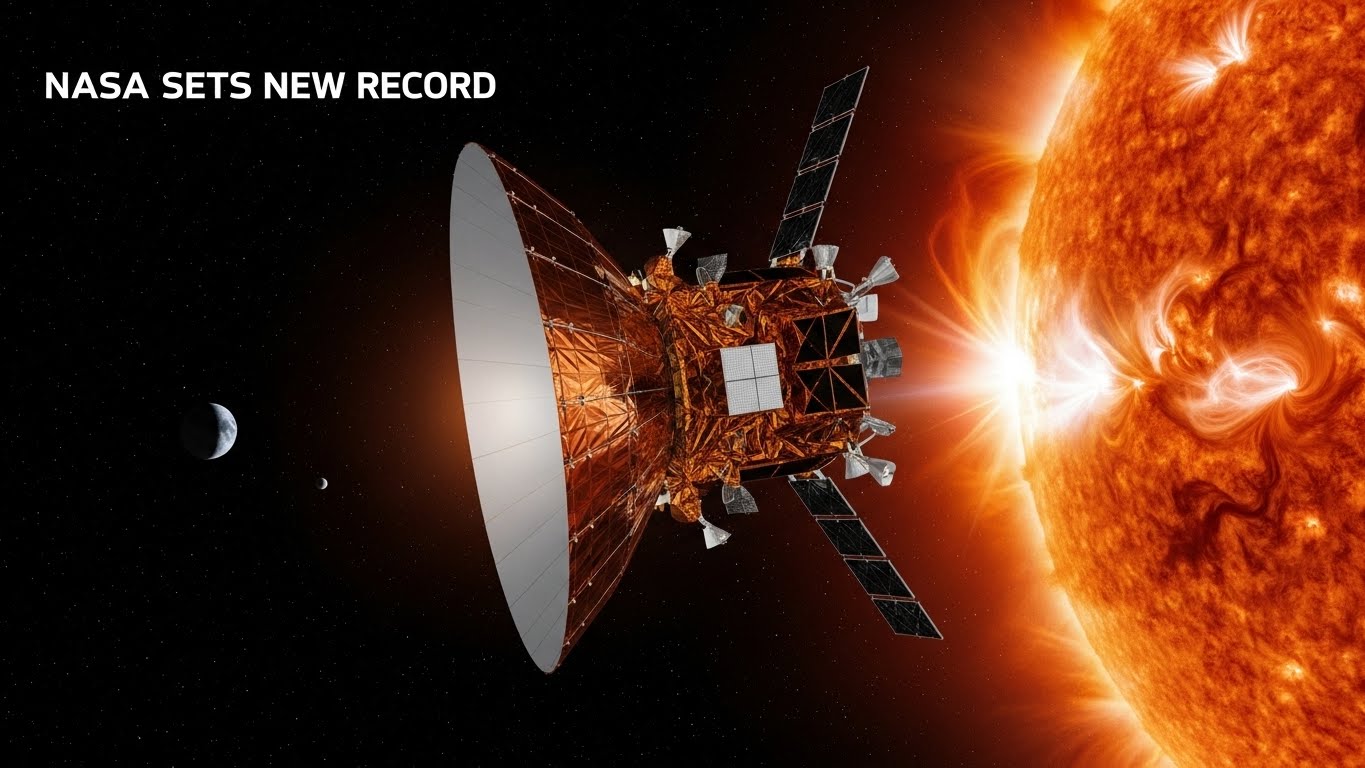

NASA’s Parker Solar Probe has reached a new record, getting just 3.8 million miles from the sun. This is a big step forward in space exploration and understanding the sun. It’s the closest any human-made object has ever been to the sun.
The mission of the Parker Solar Probe is to learn about the sun’s corona and solar wind. This recent achievement brings us closer to these goals. By getting so close to the sun, the probe shows what it can do.
This success shows NASA’s dedication to studying the sun and its effects on our solar system. The Parker Solar Probe will keep exploring, giving us more insights into the sun. This mission is crucial for understanding our solar system better.
Historic Achievement: Breaking the Solar Distance Record
The closest spacecraft to sun has made history by breaking the solar distance record. The Parker solar probe has reached a record-breaking 3.8 million miles from the sun’s surface. This achievement is thanks to its advanced technology and innovative design.
The Parker solar probe faced extreme temperatures of up to 982°C (1,800°F) on its journey. Its heat shield, a 4.5-inch (11.43cm) carbon-composite material, protected its instruments. The closest spacecraft to sun also found magnetic ‘switchbacks’ near the sun, offering new insights into solar wind and magnetic fields.
The Parker solar probe aims to better understand the sun’s corona and solar wind. This knowledge helps predict space weather and its effects on Earth. Its discoveries, like the magnetic anomalies, are crucial for heliophysics and space exploration. As the closest spacecraft to sun, it sets the stage for future solar research spacecraft.
Some key features of the Parker solar probe include:
- Speed: 430,000 miles per hour (692,000 km/h)
- Distance from sun’s surface: 3.8 million miles (6.1 million kilometers)
- Temperature endurance: up to 982°C (1,800°F)
- Heat shield material: 4.5-inch (11.43cm) carbon-composite material
Inside the Parker Solar Probe Mission
The Parker Solar Probe mission has been a groundbreaking endeavor. It made history by surviving the closest-ever approach to the Sun. Launched in 2018, the nasa sun mission aims to study the Sun’s outer atmosphere and the solar wind. The solar orbiter mission has already swept past the Sun 21 times, reaching a speed of 430,000 mph during its closest approach.
The mission’s main goals include understanding why the corona is hotter than the surface and what drives the solar wind. The spacecraft has a heat shield that can withstand scorching temperatures up to 2,500 degrees Fahrenheit. Some key features of the mission include:
- Flying within 3.8 million miles of the Sun’s surface
- Reaching speeds of up to 430,000 mph
- Enduring temperatures of up to 1,800F (980C)
Scientists aim to use data from the parker solar probe to understand the Sun’s behavior and its impact on space weather. The solar orbiter mission and nasa sun mission are collaborative efforts between NASA, Johns Hopkins Applied Physics Laboratory, and other partners, making this mission possible.
| Mission Feature | Description |
|---|---|
| Launch Year | 2018 |
| Closest Approach | 3.8 million miles |
| Speed | Up to 430,000 mph |
Revolutionary Technology Making the Closest Journey to the Sun Possible
The solar probe has made history by flying closer to the sun than ever before. This achievement is thanks to advanced technology on the closest spacecraft to sun. It includes a heat shield that can handle temperatures up to 1,377°C (2,500°F).
The solar research spacecraft has a special heat shield. It’s made of carbon composite and keeps the inside cool. This is done by reflecting light and absorbing heat, and it’s cooled by water-filled pipes.
Some key features of the solar probe include:
- A heat shield that can withstand extreme temperatures
- A cooling system that maintains a stable temperature for the spacecraft’s instruments
- A high-speed travel capability, reaching approximately 430,000 mph (690,000 kph)
The closest spacecraft to sun has completed its 21st orbit. It has gathered important data about the sun’s corona and solar wind. The solar research spacecraft will have more close encounters with the sun next year. It will give us valuable insights into solar weather and magnetic fields.
| Spacecraft | Distance from the Sun | Temperature |
|---|---|---|
| Parker Solar Probe | 3.8 million miles | up to 1,377°C (2,500°F) |
Scientific Data Collection at Unprecedented Proximity
The solar orbiter mission has reached a big milestone. The Parker Solar Probe is now just 3.8 million miles from the sun’s surface. This closest journey to the sun lets scientists study the solar corona, solar wind, and more up close. The nasa sun mission is making new discoveries that could change how we see the sun and its effects on our solar system.
Some key areas scientists are focusing on include:
- Understanding how the solar corona gets hot
- Tracing the origin of the solar wind
- Studying how energetic particles accelerate
The data from this mission will give us new insights into the sun’s behavior. The solar orbiter mission has shown it can handle extreme heat. Its shield keeps it cool, even when temperatures soar to 2,600 degrees Fahrenheit.
The nasa sun mission is expected to bring back detailed data from its recent flyby. This data will offer groundbreaking insights into solar dynamics and activities. This mission is a technological milestone in solar research. It could inspire global collaboration and future breakthroughs in heliophysics. The closest journey to the sun has opened up new paths for scientific discovery. The data collected will greatly impact our understanding of the sun and its behavior.
Overcoming Extreme Conditions in Solar Proximity
The closest spacecraft to sun, the Parker Solar Probe, has faced incredible heat. It can handle temperatures up to 2,500 degrees Fahrenheit. This solar probe is on a mission to study the sun’s corona and the solar wind’s origins. It has a special heat shield to keep its temperature stable.
The solar research spacecraft has made 21 orbits around the sun. Each orbit brings it closer to the star. At its closest point, it moves at 430,000 miles per hour. This speed is fast enough to circle the Earth 17 times in just one hour. Its heat shield, a 4.5-inch-thick carbon-composite, can handle temperatures up to 2,500 degrees Fahrenheit.
Some key features of the Parker Solar Probe include:
* A heat shield that can withstand temperatures up to 2,500 degrees Fahrenheit
* A solar array that retracts and extends as it swings closer to and further from the sun
* A advanced carbon composite heat shield that maintains stable operating temperatures in extreme conditions
| Spacecraft | Distance from Sun | Temperature |
|---|---|---|
| Parker Solar Probe | 3.8 million miles | up to 2,500 degrees Fahrenheit |
The Parker Solar Probe’s success is a big win for space exploration. It shows what can be done with technology. The mission’s findings could lead to better materials for space and new ways to generate energy.
Transforming Our Understanding of Solar Physics and Space Weather
The Parker Solar Probe’s mission is changing how we see solar physics and space weather. It got closer to the sun than ever before, just 3.8 million miles away. This close encounter brought back data that could reveal new things about our star.
The data from the probe’s fast flyby will help scientists understand solar wind and particle acceleration better. This is key for making better space weather forecasts. These forecasts are important for protecting satellites, power grids, and communication systems from solar storms.
The mission is also setting the stage for future space exploration. By studying the sun’s corona and its effects on the solar system, scientists can improve safety for astronauts and spacecraft. This could lead to better materials for heat resistance, more efficient solar energy, and a deeper understanding of Earth’s magnetic field and solar wind interactions.