
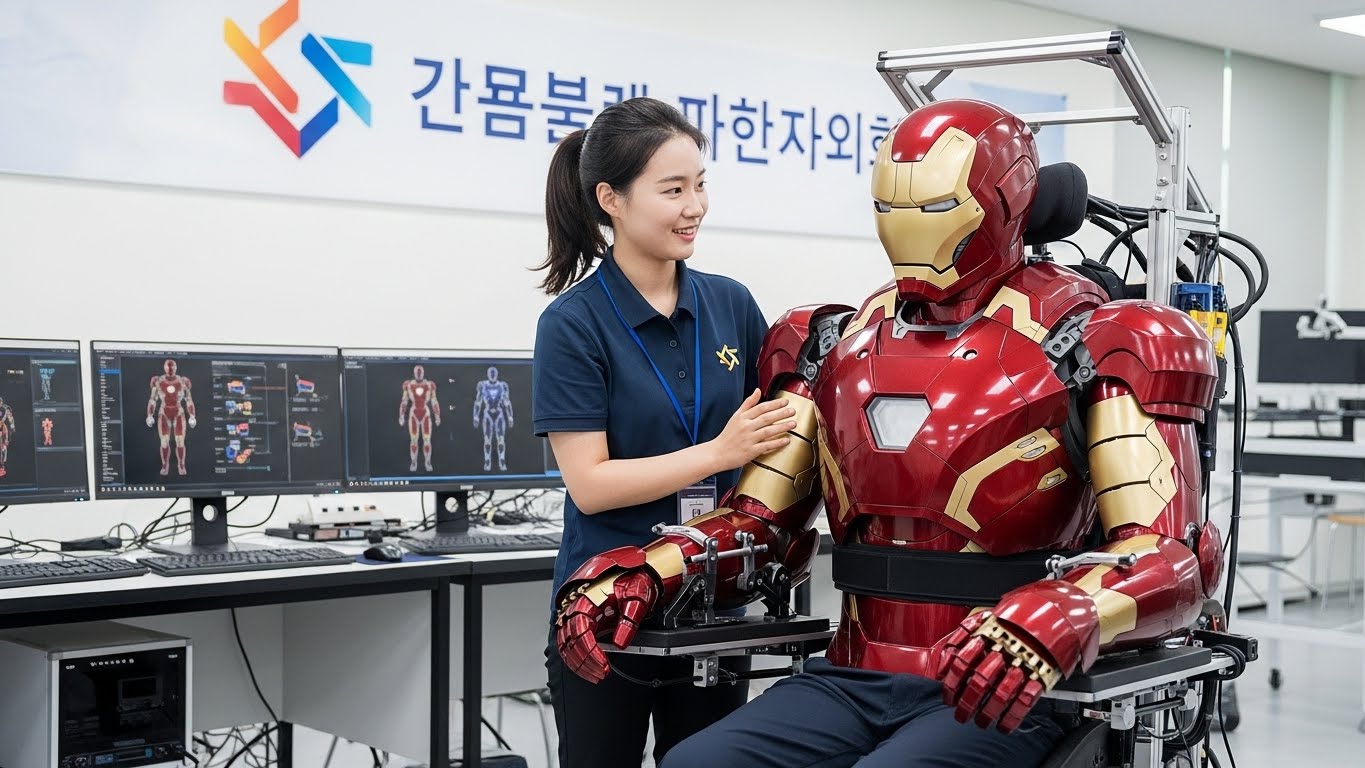

Hyundai, a South Korean car giant, has made a big leap with a new invention. It was shown at the Consumer Electronics Show (CES) in Las Vegas. The Hyundai Medical Exoskeleton (H-MEX) is like something from “Iron Man.” It helps people with lower body paralysis move around.
The H-MEX is a lightweight suit that fits around the body. It helps users walk, climb stairs, and get past obstacles. It runs on a battery that lasts up to four hours. This means users can move at speeds of up to 1.5 mph.
The H-MEX is easy to control with crutches and four thumb buttons. This lets users move the suit freely. It’s a big step forward in wearable robotics and assistive technology. It shows South Korea’s dedication to using new tech to help people with physical challenges.
Revolutionary Exoskeleton Technology from Hyundai
Hyundai, a well-known car maker, has entered the world of mobility aids and paralysis rehabilitation. They introduced the Hyundai Medical Exoskeleton (H-MEX). This bionic enhancement helps people with limited mobility.
Key Features of H-MEX Design
The H-MEX is light and easy to move around. Its legs lock at the hips and knees for stability. The upper body is connected to a metal pack that holds the batteries and controls, making it comfortable to use.
Battery Life and Performance Specifications
The H-MEX’s battery lasts up to four hours. This lets users move around easily. It can walk at speeds of up to 1.5 mph, giving users more freedom.
Control System and User Interface
The H-MEX’s control system is designed for comfort. Users control it with crutches and four thumb buttons. This makes moving, standing, and sitting easy.
Hyundai also made the Hyundai Universal Medical Assistant (HUMA) and the Hyundai Waist Exoskeleton (H-WEX). The HUMA helps those with weak muscles, and the H-WEX makes workplaces safer and more productive.
| Product | Key Specifications |
|---|---|
| Hyundai Medical Exoskeleton (H-MEX) |
|
| Hyundai Universal Medical Assistant (HUMA) |
|
| Hyundai Waist Exoskeleton (H-WEX) |
|
Hyundai’s exoskeleton technology aims to offer affordable mobility aid solutions. Unlike other expensive exoskeletons, Hyundai’s are more affordable.
‘Iron Man’-Inspired Robot for Paraplegics: A Game-Changing Innovation
Hyundai’s H-MEX exoskeleton is a game-changer for paraplegics. It’s inspired by Iron Man and aims to give back mobility and freedom. This cybernetic augmentation uses advanced sensors and robots to help people with paralysis move again.
Unlike expensive exoskeletons, Hyundai’s suits are affordable and light. This makes them more accessible to those who need them. Hyundai wants to bring this cybernetic augmentation to more people, helping them live better lives.
The H-MEX exoskeleton uses sensors like those in self-driving cars. This lets it move smoothly with the user, unlike old robotic prosthetics. It’s designed for a natural feel, making it easier to use.
| Feature | Specification |
|---|---|
| Mobility | Enables paraplegics to walk and perform everyday tasks |
| Weight | Lightweight and compact design for enhanced user comfort |
| Battery Life | Extended battery life for prolonged use |
| Control System | Intuitive user interface for seamless operation |
Hyundai’s H-MEX exoskeleton is a big step forward in assistive technology. It lets paraplegics move freely again, changing their lives. This cybernetic augmentation could help millions around the world.
Advanced Medical Applications and Target Users
The H-MEX exoskeleton from Hyundai is more than just a tool for paraplegics to walk again. It’s a game-changer for those with mobility issues. It boosts their independence and quality of life.
Benefits for Paraplegic Patients
For paraplegics, the H-MEX is a life-altering device. It gives motor support to the legs, letting them stand and walk. This reduces the physical and emotional strain of paralysis.
It boosts their autonomy, confidence, and overall well-being. Patients can now fully participate in daily life and social events.
Potential Uses in Physical Rehabilitation
The H-MEX is also great for physical rehab. It helps patients recovering from injuries, surgeries, or neurological conditions. It supports their walking, helping them regain strength and mobility.
This speeds up their path to independence and better function.
Elderly Assistance Applications
The elderly will benefit greatly from the H-MEX as the world ages. It offers mobility support, helping them stay independent. This reduces the risk of falls and mobility issues.
Integrating the H-MEX into elderly care programs can greatly improve their lives. It promotes active and fulfilling lives for seniors.
Hyundai’s H-MEX exoskeleton shows the power of paralysis rehabilitation, assistive technology, mobility aid, and wearable robotics. As it evolves, it promises to change patient care and improve lives of those with mobility challenges.
Comparing Hyundai’s Solution to Existing Exoskeletons
Hyundai’s latest exoskeleton suit is a big leap in wearable robotics. It’s different from the big and heavy powered exoskeletons out there. Hyundai’s H-MEX is lighter and easier to use for bionic enhancement.
Exoskeletons from companies like Rewalk cost a lot, from $40,000 to $80,000 USD. Hyundai’s team used their knowledge of self-driving cars to make something more affordable. The H-MEX has a special control system and lasts longer on battery, making it better for users.
Lockheed Martin has also worked on exoskeleton suits for work. But Hyundai’s focus on making it easy to move around and comfortable is unique. This makes Hyundai’s tech better for many medical and rehab uses.
Hyundai’s H-MEX shows the company’s dedication to helping people with mobility issues. It combines new tech with a design that puts the user first. Hyundai is now a top player in the powered exoskeleton field, offering a solution that’s easier to get and use for bionic enhancement.
Future Impact on Mobility Solutions and Healthcare
Hyundai’s work in assistive technology is changing the game. Their exoskeletons are set to make a big splash in many areas. This includes mobility aids, physical therapy, and even the military.
New power sources like kinetic energy harvesting could make these exoskeletons even better. The HUMA exoskeleton can carry up to 88 pounds. The H-WEX can lift 110 pounds. This means people with mobility issues can do more on their own.
As these exoskeletons get cheaper and better, they’ll help a lot of people. They’ll improve life for those with paralysis or other mobility problems. They’ll also help in jobs that need heavy lifting, elderly care, and in the military.