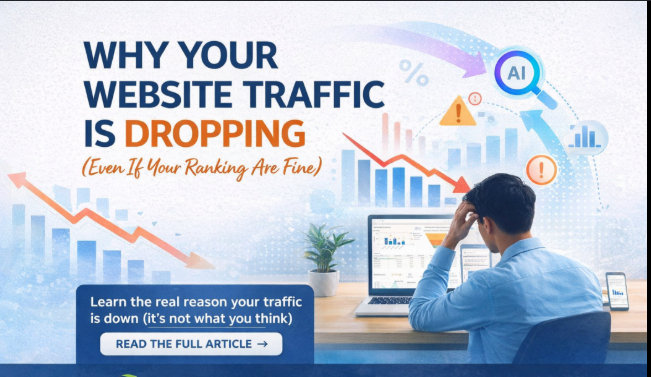

A client came to me last quarter convinced their SEO had stopped working. Rankings hadn’t moved same top-5 positions they’d held for a year. Traffic had dropped almost a third. That gap between “we’re still ranking” and “nobody’s visiting” is one of the strangest problems in SEO right now, and it’s happening to a lot of sites at once, not just this one client.
The short version: the ranking is still there. The click isn’t, because an AI Overview answered the question before anyone scrolled down to it.
What’s Actually Happening to Clicks Right Now
Quick Answer: AI Overviews now appear on a large share of Google searches and pull clicks away even from pages ranking in position one. The ranking hasn’t broken, the SERP around it has changed shape, and that changes how much of that ranking is actually worth.
The scale of this is bigger than most people realize until they see the numbers. AI Overviews now appear in 25.11% of Google searches, up from 13.14% in March 2025, roughly doubling in a year. And when they appear, the effect on clicks is not subtle. Around 93% of AI search sessions end without a website click at all, and AI Overviews reduce clicks to the top-ranking page by 58%.
It gets more specific by query type. When an AI Overview appears, it doesn’t just reduce clicks, it ends the browsing session entirely for 26% of users, according to Pew Research’s behavioral tracking of actual search sessions. That’s a quarter of your potential audience who type a query, read the AI summary, and never open a single result including yours, even if you’re the top one.
The upside, if there is one: over 50% of Google AI Overview citations come from pages already ranking in the top 10. Your existing rankings aren’t wasted they’re the raw material AI Overviews pull from. But “raw material for a summary” and “a click on your site” are two very different outcomes, and only one of them shows up as revenue.
Why Rank Tracking Alone No Longer Tells the Full Story
Quick Answer: A traditional rank tracker tells you your position on the page, it doesn’t tell you whether an AI Overview sits above that position and absorbs most of the clicks before a user ever reaches it. You need both position and SERP-feature context, together, to understand what’s actually happening.
This is the part that trips people up. Position #3 today isn’t the same product it was two years ago. If there’s an AI Overview, a shopping carousel, and a People Also Ask block stacked above it, position #3 might be functionally invisible. Two sites can hold identical rankings and get wildly different traffic, purely because of what Google decided to stack on top of one result and not the other.
That’s why watching position alone increasingly misses the point. What matters now is position plus what else occupies that SERP and whether that composition is changing over time. This is exactly the gap FreeSERP‘s Real-Time SERP Analysis is built to close: instead of just logging “position 3,” it captures the actual SERP layout around that ranking, so you can see when an AI Overview shows up on a keyword you’re tracking, not just infer it from a traffic drop three weeks later. Paired with Rank Tracking and Historical Ranking Data, you get a timeline was the ranking always this “quiet,” or did the click-through collapse coincide with an AI Overview appearing on that specific query?
That distinction changes what you do next. A genuine ranking drop calls for content or technical fixes. A stable ranking with a new AI Overview above it calls for a completely different response optimizing to be the source the AI Overview cites, not just the page underneath it.
How to Actually Diagnose an AI-Overview Traffic Drop?
Compare your ranking history against your traffic history for the same keywords, if position held steady while clicks fell, check whether an AI Overview now appears on that query. If it does, the fix is about earning the citation inside the summary, not chasing a rank you already have.
Step-by-step diagnosis
- Pull your top organic keywords by traffic, sorted by biggest year-over-year or month-over-month decline.
- Cross-reference against ranking history for the same keywords.If position is flat or improved but traffic dropped, that’s your signal.
- Manually check whether an AI Overview now appearsfor those specific queries, this is the step most people skip and the one that actually confirms the cause.
- Check whether your content is being cited inside the AI Overview, not just ranking below it. Some pages get cited and still see traffic; others rank and get nothing.
- Segment by query type.Informational, “how to,” and definitional queries are hit hardest; transactional and highly specific long-tail queries are far less affected.
What the data says about who’s hit hardest
Not every page category takes the same hit. Informational content like blogs and knowledge bases sees on average 23% less organic traffic than three years ago, while product pages show only a 4% decline, the AI-Overview effect concentrates heavily on “explain this to me” content, not “sell me this” content.
What to Actually Do About It
Quick Answer: Don’t try to fight AI Overviews by chasing higher rankings on queries where they already dominate the SERP, the win now is getting cited inside the summary, since cited brands see meaningfully better outcomes than merely-ranked ones.
The data on citation vs. ranking
This is the part worth building strategy around. Brands cited inside AI Overviews get roughly 35% more organic clicks and 91% more paid clicks than those that aren’t. Being the source Google’s AI chose to quote is worth more than an extra rank position on a query where the AI Overview already owns the top of the page.
Practical tactics
- Write in directly quotable, self-contained statements.AI summarization tools favor content that states a fact or answer cleanly in one or two sentences, rather than requiring the reader to piece it together across paragraphs.
- Keep content current.Freshness correlates with citation likelihood, content updated within 2 months earns 28% more citations than older content.
- Don’t abandon the SERP checks just because a query has an AI Overview.Some queries with AI Overviews still send meaningful clicks below the fold, you won’t know which without checking the actual layout, not assuming based on the presence of the feature alone.
- Track this at the keyword level, continuously, not as a one-off audit. AI Overview presence on a given query isn’t fixed, it appears, disappears, and changes format over time, which is exactly the kind of shift Daily Monitoring in an SEO Dashboard is meant to catch before you notice it purely from a traffic dip.
Common Mistakes When Reacting to AI Overview Traffic Loss
- Assuming a traffic drop means a ranking drop, and rewriting content aimed at improving position when position never actually moved
- Ignoring query-level SERP composition and only ever looking at the aggregate site traffic chart
- Chasing AI citation with vague, unquotable prose instead of clear, standalone factual statements
- Treating every AI Overview appearance as equally damaging transactional and highly specific queries are far less affected than broad informational ones
- Giving up on informational content entirely, it still drives citations, brand visibility, and the traffic that does convert at a higher rate
Diagnostic Checklist
- Pulled top keywords by traffic decline
- Cross-referenced ranking history for the same keywords, flat/improved position with falling traffic is the key signal
- Manually confirmed whether an AI Overview now appears on the affected queries
- Checked whether content is cited inside the AI Overview, not just ranking below it
- Segmented the affected keywords by informational vs. transactional intent
- Reviewed content freshness on the affected pages
- Set up ongoing SERP-feature monitoring for tracked keywords rather than a one-time check
FAQ
Why did my traffic drop even though my rankings stayed the same? An AI Overview or other SERP feature likely now sits above your result, absorbing clicks before users reach your ranking.
Do AI Overviews replace organic rankings? No, they sit above them, but rankings still matter because most AI Overview citations come from already-ranking pages.
Can I track whether an AI Overview appears on my keywords? Yes, by regularly checking the live SERP for tracked keywords rather than relying on rank position alone.
Which content types are hit hardest by AI Overviews? Informational and “how to” content sees the steepest traffic decline; transactional and product-focused pages are affected far less.
Is it worth still ranking #1 if an AI Overview sits above me? Yes, top-ranking pages are the most common source AI Overviews cite, so ranking well still matters, just for a different outcome than a direct click.
How do I get my content cited inside an AI Overview? Write clear, self-contained, factual statements that can stand alone as an answer, and keep the content current.
Does content freshness affect AI citation rates? Yes, more recently updated content earns meaningfully more AI citations than older, stale pages.
What percentage of searches now end without any click? Estimates vary by study and region, generally landing somewhere between 58% and 68% in 2026, depending on methodology.
Do AI Overviews appear on every type of query? No, they concentrate more heavily on informational and definitional queries than on highly specific transactional ones.
Should I stop creating informational content because of AI Overviews? No, it still drives citations and brand visibility, and cited content sees stronger click and conversion outcomes than uncited content.
How is tracking AI Overview visibility different from normal rank tracking? Normal rank tracking shows position; AI Overview tracking requires checking the actual SERP layout to see what’s stacked above that position.
Can two pages with the same ranking get very different traffic? Yes, if one has an AI Overview or other SERP feature above it and the other doesn’t, the traffic outcome can differ significantly despite identical rankings.
Do AI Overviews affect mobile and desktop the same way? Not necessarily, SERP feature presence and impact can vary by device, so it’s worth checking both separately.